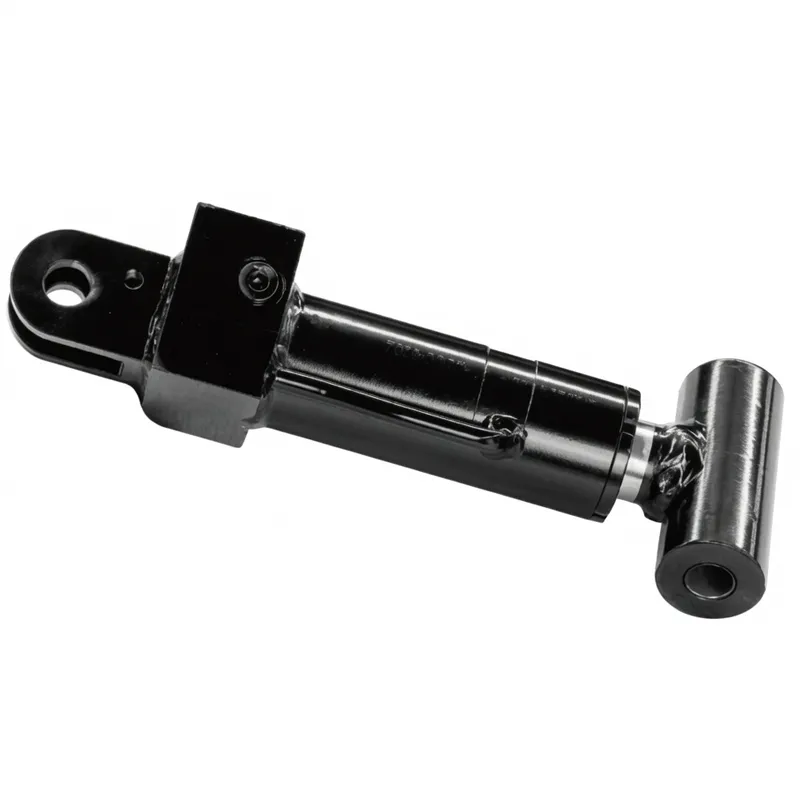
Cilindro de nivelación superior EP-Φ40×Φ25×100×2 para vehículos de trabajo aéreo
1. Technical Specifications
Complete dimensional and performance parameters for the EP-Φ40×Φ25×100×2 upper leveling cylinder as supplied for aerial work vehicle applications.
| Parameter | Value | Notes |
|---|---|---|
| Cylinder Model | HCYY11112008 | EP Series Upper Leveling |
| Specifications (Bore × Rod × Stroke) | Φ63 × Φ45 × 60 mm | Double acting |
| Working Pressure | 25 MPa | Continuous rated |
| Maximum Withstand Pressure | 30 MPa | Proof / test pressure |
| Stroke (Trip) | 60 mm | Full leveling travel range |
| Installation Distance | 375 mm | Pin-to-pin retracted |
| Weight | 16 kg | Fully assembled |
| Hydraulic Port (Metric) | 2 × G3/8 | Standard European fitting |
| Hydraulic Port (Imperial) | 2 × 7/8-14 UNF | SAE / imperial option |
| Port Angle | 20° | Angled for hose routing |
| Clevis Pin Diameter | Φ28 mm (R1) | Both end attachments |
| Clevis Eye Radius | R30 mm | Front and rear clevis |
| Rear Mount Bolt Pattern | 2 × M10 | Anti-rotation mounting |
| Overall Envelope (Height × Width) | 144 mm × 115 mm | Max cross-section |
| Mount Block Footprint | 95 × 40 mm | Base plate section |
| Actuation Type | Doble acción | Extend and retract powered |
| Application | Aerial Work Platform | Upper boom articulation joint |
2. What Is an Upper Leveling Cylinder?
An upper leveling cylinder is a hydraulic actuator installed on articulating and telescopic boom aerial work platforms to automatically maintain the working platform in a level position as the boom changes elevation angle. In boom-type aerial work vehicles — widely used across the construction, infrastructure, and utility sectors in France and throughout Europe — the operator platform must remain horizontal regardless of whether the boom is extended horizontally, angled at 45 degrees, or elevated to full vertical reach. Without a precisely calibrated upper leveling cylinder driving the platform linkage, the basket would tilt dangerously with every change in boom angle, making the machine unable to meet the safety requirements set out in EN 280 and related European standards. The upper leveling cylinder prevents this tilt by mechanically restoring the platform to horizontal at every boom angle change.
The EP-Φ40×Φ25×100×2 upper leveling cylinder is a short-stroke double-acting hydraulic cylinder purpose-built for this leveling function. It operates as part of a master-slave hydraulic circuit in which a lower leveling cylinder at the boom pivot tracks the boom angle mechanically, and the upper leveling cylinder at the platform joint translates that angular motion into a compensating angular correction. The result is continuous, automatic platform leveling throughout the full operating envelope of the machine — typically ±75 degrees from horizontal — without any input from the operator.
With a bore of Φ63 mm, rod diameter of Φ45 mm, and a 60 mm stroke, this upper leveling cylinder delivers the precise, repeatable motion that leveling systems demand. The upper leveling cylinder rated working pressure of 25 MPa and maximum withstand pressure of 30 MPa give ample safety margin for the shock loads and pressure transients that occur during normal machine operation on uneven ground or when the platform is suddenly occupied at full extension.
3. Five Key Advantages of the EP Upper Leveling Cylinder
What distinguishes this upper leveling cylinder from commodity alternatives in the aerial work platform market.
1. Precision Bore and Rod Tolerances
The Φ63 bore is honed to H7 tolerance and the Φ45 rod ground to f7, producing a radial clearance that maintains consistent oil film without allowing lateral play to develop. In the upper leveling cylinder the rod is in bending as well as axial compression and tension, and the upper leveling cylinder dimensional accuracy at the rod-seal interface, so dimensional accuracy at the rod-seal interface directly affects how long the cylinder operates without leakage in service.
2. 25 MPa Rated Working Pressure
Operating at 25 MPa with a proof pressure of 30 MPa, this upper leveling cylinder head assembly is built for the high-pressure circuits common in modern aerial work platforms. The 20% pressure margin above working load accommodates dynamic pressure spikes from sudden platform occupation and machine travel over rough terrain — making this upper leveling cylinder reliable even in the most demanding site conditions.
3. Compact 60 mm Stroke, 375 mm Installation
The short 60 mm stroke of this upper leveling cylinder is precisely matched to the angular travel range of the platform linkage — a longer stroke would waste packaging space and add unnecessary rod exposure to the corrosive environment at the upper boom articulation. The 375 mm installation distance fits the standard upper-boom geometry of most articulated boom platforms without modification to the machine frame.
4. Dual G3/8 Port Configuration
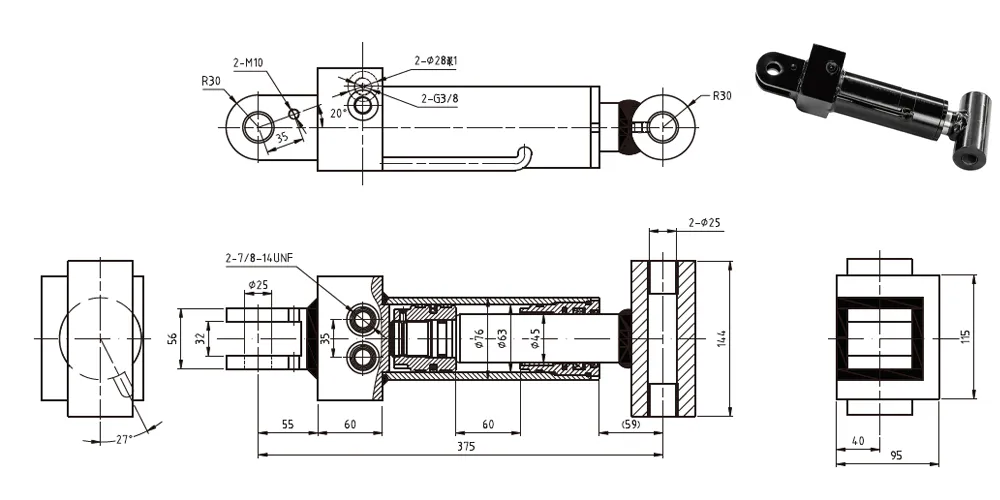
Two G3/8 hydraulic ports — with an alternative 2-7/8-14 UNF thread option — give this upper leveling cylinder direct compatibility with the hose connections standardised on European-manufactured aerial work platforms, reducing on-site installation time and the risk of thread damage from mismatched fittings. The 20-degree port angling shown in the dimensional drawing ensures hoses route cleanly in the restricted space of the upper boom articulation zone.
5. Heavy-Duty Clevis Mount with R30 Pins
The front and rear clevis mounts use Φ28R1 bearing pins with R30 radius clevis eyes, providing articulated end fixings that absorb the complex loads at the boom linkage connection points without introducing bending stress into the cylinder barrel. The 2-M10 bolt pattern on the rear mount gives a positive location against rotation that plain pin fixings alone cannot provide, simplifying installation and maintaining alignment during full leveling travel.
4. How Does the Upper Leveling Cylinder Work?
The leveling system on an aerial work platform operates on a hydrostatic master-slave principle. A lower leveling cylinder — mounted at the main boom pivot on the turntable — is mechanically linked to the boom structure so that as the boom raises or lowers, the lower cylinder automatically displaces oil in direct proportion to the boom angle change. This displaced oil is routed through dedicated leveling hoses to the upper leveling cylinder at the platform attachment joint. Because the oil displaced by the lower cylinder is precisely metered in proportion to the boom angle change, the upper leveling cylinder receives exactly the volume of oil needed to rotate the platform joint by an equal and opposite angle — keeping the platform basket level throughout the full range of boom elevation.
This upper leveling cylinder mechanism functions without electronic control or solenoid valves during normal operation — the hydraulic geometry of the master-slave circuit makes the leveling automatic and continuous. The upper leveling cylinder must therefore respond smoothly and without stick-slip at any position within its 60 mm stroke. Stick-slip — caused by seal friction that is too high relative to the applied force — produces a jerkiness in platform leveling that is immediately felt by the operator and that can cause the platform to over-correct and oscillate. The precision bore finish, low-friction seals, and carefully specified radial clearance in this cylinder are all directed at eliminating stick-slip throughout the operating life of the unit.
In emergency lowering mode — when hydraulic power is unavailable — some platform designs allow manual override of the leveling circuit. The upper leveling cylinder must in this case tolerate controlled back-driving without damage to seals or end fittings, a requirement that shapes the end-cap thread engagement length and the seal groove geometry visible in the cross-section drawing. The double-acting configuration of the EP upper leveling cylinder handles both extension and retraction with equal precision, ensuring that the platform remains level whether the boom is rising or descending.
5. Materials and Construction
The material selection for an upper leveling cylinder used in aerial work platform service is driven by three competing requirements: high strength to handle the working and proof pressures, corrosion resistance to survive the outdoor environment typical of aerial work platforms in France and Northern Europe, and tight dimensional stability to maintain the bore and rod tolerances needed for low-friction, leak-free operation throughout the service life. Every component in this upper leveling cylinder is specified with these demands in mind.
Cylinder Barrel
Cold-drawn seamless steel tubing (20# or 45# carbon steel) with honed bore surface to Ra 0.4 µm or better. Honing creates the cross-hatched oil retention pattern essential for controlled lubrication at the piston seal contact face during reciprocating motion.
Piston Rod
45# carbon steel or 40Cr alloy steel, precision-turned and induction-hardened to 50–60 HRC on the outer surface, then chrome-plated to 20–25 µm hard chrome with a final ground finish to Ra 0.2 µm or better. Hard chrome provides the wear and corrosion resistance that rod seals depend on for long service life.
End Caps and Clevis Fittings
Forged or machined from 45# steel with thread engagement and seal groove dimensions calculated to maintain seal compression at 30 MPa proof pressure without gasket yielding. Clevis eyes are stress-relieved after machining to prevent fatigue cracking at the pin bore under the cyclic bending loads of platform leveling duty.
Sealing System
Polyurethane rod seals, PTFE-backed piston seals, and NBR O-ring static seals — all rated for operation with mineral hydraulic oil (ISO VG 46 or 68) and hydraulic fluid temperatures from −25 °C to +80 °C. The wiper seal prevents ingress of the dust and grit that accumulates on outdoor construction sites in France and across the EU — a protection that directly extends the service interval of the upper leveling cylinder seal package.
Surface Protection
External surfaces of the barrel and end caps receive a two-coat paint system — epoxy primer plus polyurethane topcoat — providing salt-spray resistance exceeding 480 hours to ISO 9227. The piston rod is protected by the hard chrome coating. Bare clevis bore surfaces are treated with phosphate conversion coating prior to painting to prevent corrosion in the unmachined bore before pin installation.
6. Application Scenarios
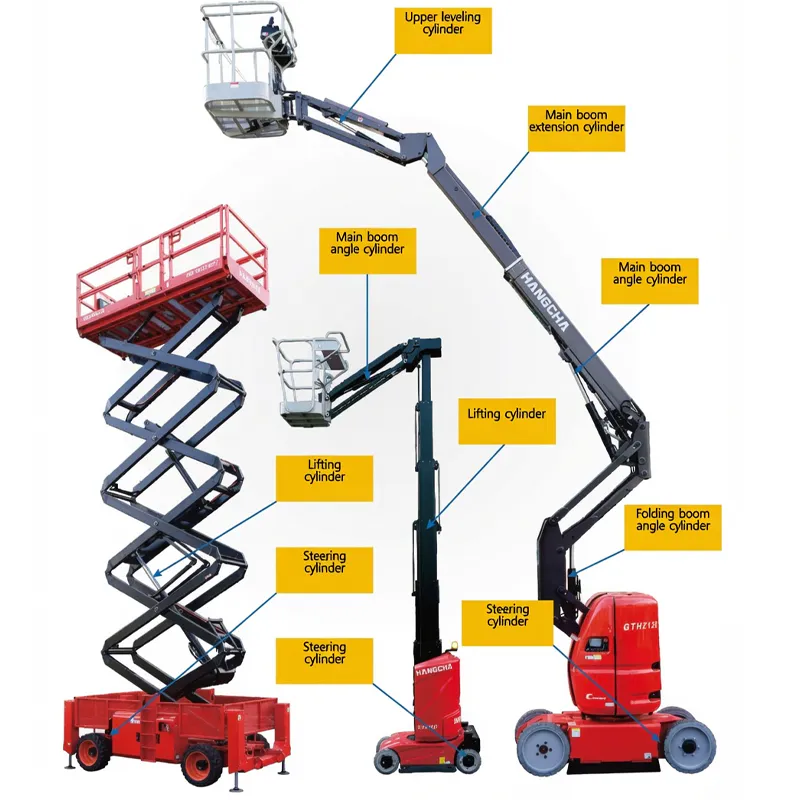
The upper leveling cylinder serves as the critical platform stabilisation actuator across a wide range of aerial work platform types deployed in France and across Europe. The following scenarios illustrate where this leveling hydraulic cylinder delivers the most direct operational value.
Articulating Boom Lift
On articulating boom platforms — the most common type used for building maintenance and facade work in French cities — the upper boom can articulate independently of the lower boom, requiring the upper leveling cylinder to compensate for the combined angular change of both boom sections. The 60 mm stroke of this upper leveling cylinder covers the full articulation range — the upper leveling cylinder stroke is matched specifically to the angular geometry of the upper boom pivot linkage of standard two-section boom designs without bottoming or topping out during normal operation.
Telescopic Boom Lift
Telescopic boom platforms — preferred for construction work at height in French and European industrial facilities — use a single upper leveling cylinder at the platform joint to maintain level as the boom extends and retracts. The upper leveling cylinder operates at constant stroke position during extension, with corrections occurring only when boom elevation changes, making this a lower-duty upper leveling cylinder application that nonetheless demands the same sealing and structural integrity as articulated designs.
Bucket Truck / Aerial Line Work
Utility and electrical line maintenance vehicles — known in France as camions nacelle — mount an upper leveling cylinder at the basket joint to keep linemen level while working on overhead infrastructure at up to 40 metres height. The 25 MPa working pressure of this upper leveling cylinder is appropriate for the higher-capacity bucket trucks used by ENEDIS and French telecom infrastructure contractors, where basket capacities up to 300 kg impose substantial pressure demands on the leveling circuit.
Bridge Inspection Equipment
Bridge inspection platforms deployed by French road and rail infrastructure operators — including SNCF Réseau and autoroute concession holders — use articulated booms with upper leveling cylinders to position inspectors under and alongside bridge structures. In this application the boom often operates at steep downward angles, requiring the upper leveling cylinder to sustain maximum extension pressure over long periods while the inspector performs visual and NDT assessments of bridge components.
Tree Care and Urban Maintenance
Municipal boom trucks used for urban tree pruning, street lamp maintenance, and sign servicing in France's communes and agglomérations frequently operate on sloped or uneven road surfaces where the machine levelling jack cannot fully compensate for ground irregularity. In these conditions the leveling jack cylinder at the boom head must work harder than on level ground, making the 30 MPa proof pressure safety margin particularly valuable for municipal operators who cannot control site conditions.
7. Regulatory Compliance — France and European Markets
The upper leveling cylinder for aerial work platform applications is subject to a multi-layer regulatory framework in France and across the EU. Buyers and OEMs should verify compliance at both the component and complete-machine level before deployment in regulated working environments.
EN 280:2013+A1:2015 (France / EU)
The primary European standard for mobile elevating work platforms (MEWPs) governs the design, calculation, stability criteria, and testing of the complete platform including the leveling system. The upper leveling cylinder must sustain the rated load at full extension at maximum boom angle without exceeding defined deflection limits — a test condition that the 25 MPa working pressure and Φ63 bore diameter of this cylinder are designed to satisfy.
EU Machinery Directive 2006/42/EC
All aerial work platforms sold in France and EU member states must carry CE marking under the Machinery Directive, which requires the hydraulic system — including the leveling circuit and the upper leveling cylinder — to be documented in the technical file with pressure calculations, hose routing diagrams, and hydraulic schematic. The cylinder must demonstrate compliance with the Essential Health and Safety Requirements of Annex I covering hydraulic and pneumatic components.
ISO 4413: Hydraulic Fluid Power
ISO 4413 sets the international general rules for hydraulic systems on mobile machinery including MEWPs. Its requirements for pressure rating, proof pressure testing, burst pressure factors, and hydraulic cylinder installation practices directly shape how the leveling hydraulic cylinder must be rated, tested, and installed. The proof-to-working pressure ratio of this upper leveling cylinder (30 MPa / 25 MPa) is specifically sized to meet the EN 280 leveling circuit proof test requirement. The upper leveling cylinder pressure rating (30 MPa / 25 MPa = 1.2×) complies with EN 280 leveling circuit requirements.
Code du Travail (France) — Work at Height
French labour law under Articles R4323-58 to R4323-91 of the Code du Travail mandates that MEWPs used by French employers must be in conformity with applicable European standards including EN 280, undergo periodic inspection by a qualified inspector (contrôleur technique), and maintain maintenance records accessible to the inspection authorities (DREETS). The leveling system inspection records must document cylinder condition, pressure test results, and seal replacement history.
ANSI A92.20 (USA Export)
For OEMs supplying aerial work platforms to the North American market, ANSI A92.20 governs MEWP design requirements, and the leveling system must satisfy the stability and leveling accuracy requirements of that standard. The 7/8-14 UNF hydraulic port option on the EP upper leveling cylinder simplifies integration into US market hydraulic systems that use SAE port and fitting standards rather than the ISO/DIN metric threads standard in Europe.
RoHS and REACH (EU Chemical Regulations)
The surface treatment and seal materials of the upper leveling cylinder must comply with REACH regulation (EC) 1907/2006 restrictions on hazardous substances in industrial components. Hard chrome plating is subject to REACH authorisation requirements in the EU under SVHC listing of hexavalent chromium compounds. Manufacturers supplying this cylinder to French and EU customers should be able to provide REACH compliance declarations confirming the chrome plating process meets current authorisation conditions.
8. Related Hydraulic Products
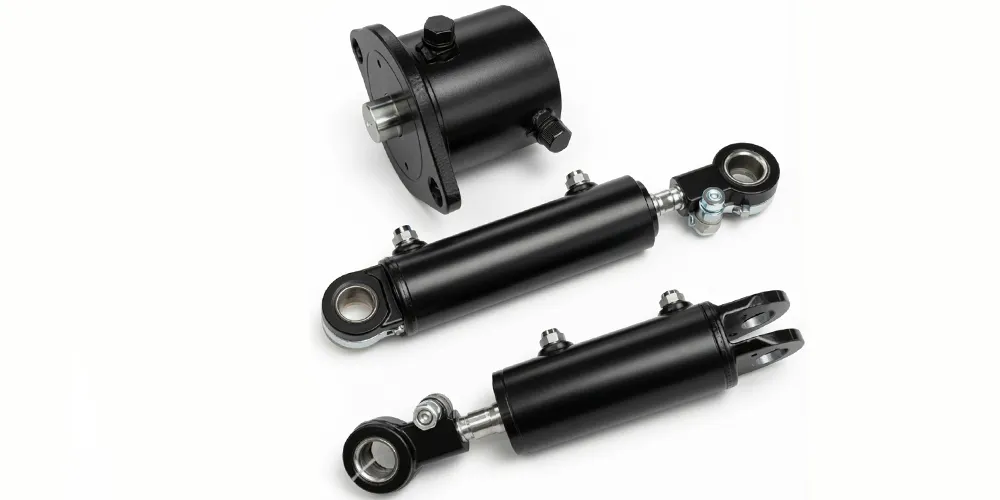
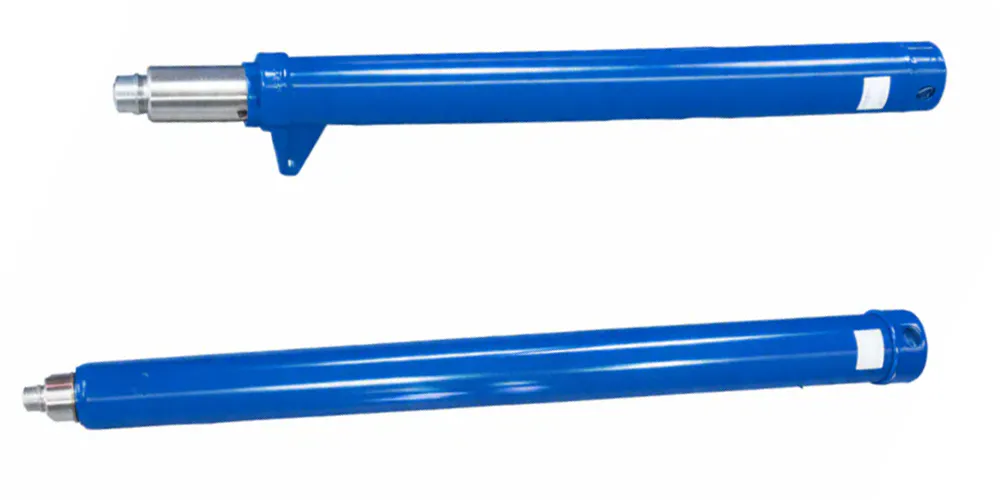
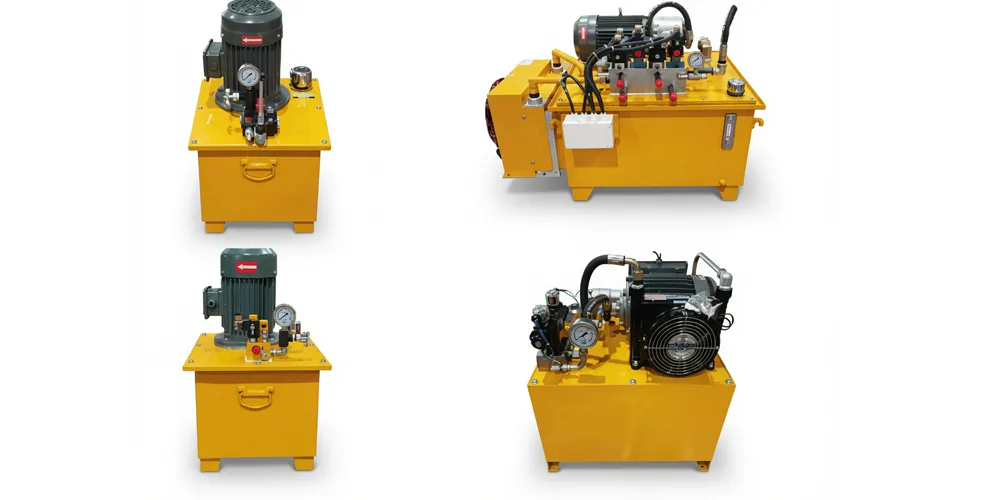
We supply a complete range of hydraulic cylinders and components that integrate with the upper leveling cylinder in aerial work platform hydraulic systems — providing a single-source supply advantage for OEMs and service operators.
9. About Our Hydraulic Cylinder Manufacturing
We are a specialist hydraulic cylinder manufacturer with deep experience in the aerial work vehicle, materials handling, and industrial machinery sectors. Our engineering team has decades of combined experience in hydraulic cylinder design, and our manufacturing facility operates under a certified quality management system covering the full production cycle from raw material inspection through final pressure testing. Every upper leveling cylinder we produce undergoes dimensional verification, load testing at working pressure, load testing at working pressure, and a 100% seal leak test before dispatch, backed by documentation packages that support machine builder technical files under EU Machinery Directive requirements.
We supply hydraulic cylinder components to OEMs, distributors, and maintenance operators across France, the EU, and internationally. Our commitment to on-time delivery, precise conformance to drawing specifications, and responsive technical support has made us a preferred supplier for aerial work platform manufacturers and service organisations in the French market where equipment downtime during maintenance windows carries significant contractual penalty exposure. Custom upper leveling cylinder configurations — including non-standard stroke lengths, port positions, and special rod end geometries — are available for OEM volumes with full traceability documentation.
Frequently Asked Questions
Editor: PXY