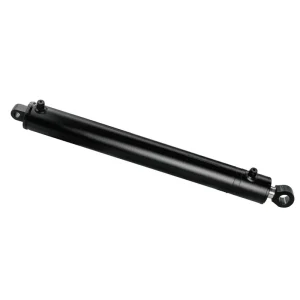
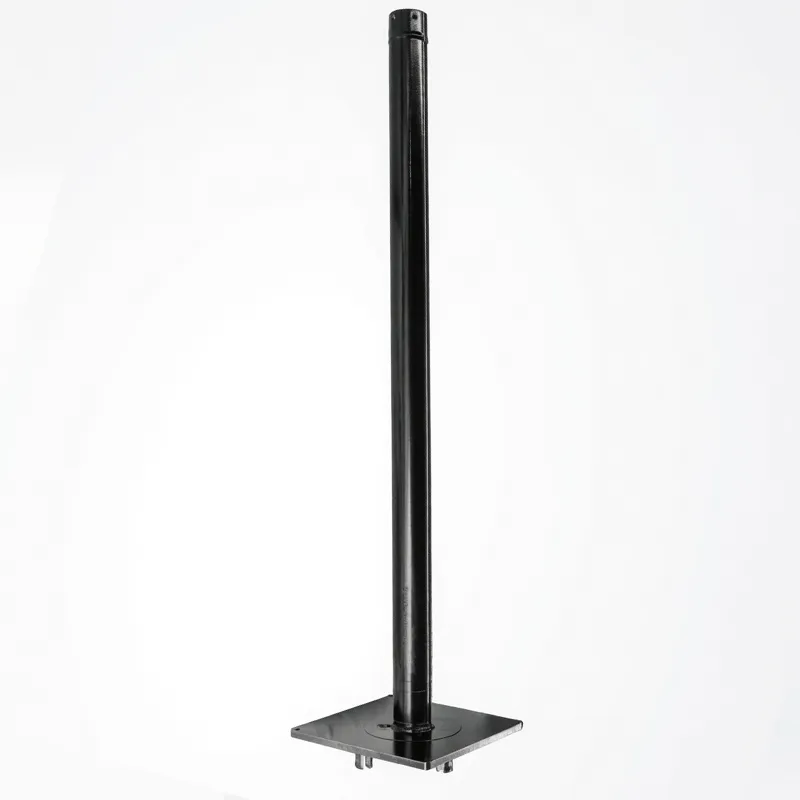
Cilindro di sollevamento per veicolo di lavoro aereo EP-Φ65×Φ45×1260
The EP-Φ65×Φ45×1260 is a long-stroke single-stage hydraulic lifting cylinder designed specifically for the elevation circuits of aerial work vehicles — scissor lift platforms, articulated boom lifts, telescopic boom platforms, and trailer-mounted elevated work platforms. The cylinder extends the platform to its rated working height when hydraulic oil under pressure pushes the piston from its retracted position through the full 1260 mm stroke. With a robust Φ65 mm bore, Φ45 mm precision-ground hard chrome rod, and 54 kg structural weight, this hydraulic lift cylinder provides the load-bearing capacity and cyclic durability demanded by aerial work equipment in French construction, maintenance, and industrial installation applications where operator safety at height is governed by strict European workplace regulations.
Aerial Work Vehicle Cylinder Series
Cilindro di sollevamento per veicolo di lavoro aereo EP-Φ65×Φ45×1260
A heavy-duty single-acting lifting cylinder engineered for scissor lift platforms, boom lift aerial work vehicles, and elevated work platforms. Model HCYY11112006, specifications Φ65×Φ45×1260 mm, rated at 18 MPa working pressure with 27 MPa maximum withstand pressure, 1260 mm stroke, 1629 mm installation distance, 54 kg. This lifting cylinder is trusted by aerial work vehicle manufacturers and MRO engineers across France, Benelux, and the European access equipment sector.
Key Technical Facts at a Glance
HCYY11112006
Φ65 mm
Φ45 mm
1260 mm
18 MPa
27 MPa
1629 mm
54 kg
1. Technical Specifications — EP-Φ65×Φ45×1260 Aerial Lifting Cylinder
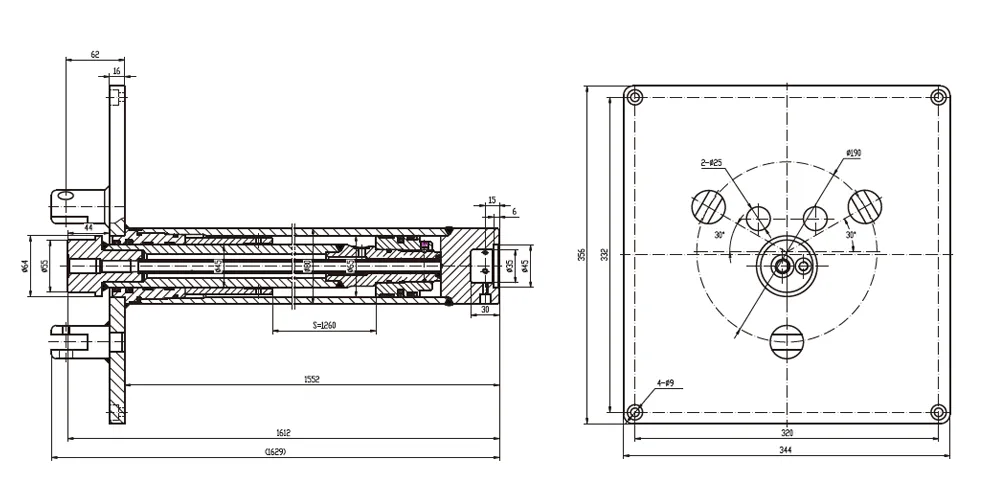
Model: HCYY11112006. Specification: Φ65 × Φ45 × 1260 (bore × rod × stroke, all in mm). Mounting: wide flange plate, 2-G25 central port. This lifting cylinder has overall envelope dimensions extracted from dimensional drawing.
| Parameter | Value | Notes |
|---|---|---|
| Cylinder Model | HCYY11112006 | OEM part number for aerial work vehicle cylinder series |
| Specification | Φ65 × Φ45 × 1260 | Bore Φ65 mm, rod Φ45 mm, stroke 1260 mm |
| Working Pressure | 18 MPa | Rated continuous operating pressure (180 bar) |
| Maximum Withstand Pressure | 27 MPa | Static proof pressure; safety factor 1.5 over working pressure |
| Stroke (Trip) | 1260 mm | Total rod travel from fully retracted to fully extended position |
| Installation Distance | 1629 mm | Pin or flange face to rod tip center distance in fully extended position |
| Weight | 54 kg | Unit weight without hydraulic fluid |
| Cap End Mounting Flange | 344 mm × 344 mm square plate | 4-bolt mounting, 4 × Φ9 mm holes at 320 mm × 320 mm pitch circle |
| Cap End Port | 2-G25 (central port on flange plate) | Hydraulic connection at centre of cap flange with 2 ports at 30 degrees spacing |
| Rod End Attachment | Threaded rod end or pin eye | Connects to scissor arm pivot bracket or platform structure interface |
| Flange Plate Detail | Φ150 pilot register circle; 205 mm centre clearance dimension | Pilot register locates cylinder central axis to frame bore for concentricity |
| Cylinder Type | Single-acting hydraulic lift cylinder (gravity return) | Pressure extends rod; controlled lowering valve allows gravity return |
| Applicazione | Aerial work vehicle elevation circuit | Scissor lifts, boom lifts, trailer-mounted elevated work platforms |
2. What Is an Aerial Work Vehicle Lifting Cylinder?
An aerial work vehicle lifting cylinder is a long-stroke hydraulic lift cylinder that forms the primary elevation actuator in scissor lift platforms, boom lift aerial work vehicles, and trailer-mounted elevated work platforms. Unlike the short-stroke tilt cylinders or fork lift cylinders used in material handling equipment, the lifting cylinder for an aerial work platform must extend through several hundred to well over a thousand millimeters while supporting the combined static weight of the platform structure, operators, tools, and rated payload at height. The 1260 mm stroke of the EP-Φ65×Φ45×1260 lifting cylinder represents its usable travel from fully retracted to fully extended position, directly determining the maximum working height contribution of this cylinder stage in the overall platform elevation mechanism.
In scissor lift applications — the most common configuration where this lifting cylinder size is specified in the French and European access equipment market — the lifting cylinder is positioned vertically below the scissor arm assembly and pushes the scissors apart as it extends, converting the cylinder linear stroke into vertical platform height through the scissor linkage geometry. The elevation force available from this lifting cylinder at 18 MPa working pressure with a Φ65 mm bore area of 3,318 mm² reaches approximately 59.7 kN — equivalent to lifting approximately 6,087 kg — well above the typical combined load of 500 to 1,000 kg at working height for standard category scissor lifts used on French construction sites and industrial facilities.
The hydraulic lift cylinder operates as a single-acting design in most scissor lift applications: hydraulic oil pressure from the pump extends the lifting cylinder and raises the platform, while a lowering valve controls the return of oil to the reservoir as the platform descends under its own weight. The large mounting plate at the cap end — clearly visible in the dimensional drawing with its 344 mm square footprint, four 9 mm mounting bolts in a 320 mm square pattern, and 2-G25 central port — provides the wide load distribution area needed to spread the lifting cylinder reaction force across the scissor frame without local stress concentration at the attachment points, a structural requirement that becomes critical during asymmetric load conditions when one side of the platform carries more weight than the other.
3. Five Key Product Advantages
1260 mm Long Stroke for Maximum Platform Elevation Contribution
The 1260 mm stroke of this lifting cylinder delivers the extended reach required by scissor lift and boom lift architectures where the cylinder must travel a substantial linear distance to achieve the target working height through scissor linkage multiplication or direct boom extension. In a typical double-scissors platform, the lifting cylinder stroke may be multiplied 3 to 4 times by the scissor geometry, meaning this single lifting cylinder provides a vertical height contribution of 3.8 to 5 meters — covering the majority of the working height range for standard-class scissor lifts used across French construction and industrial maintenance applications.
Wide Flange Mounting Plate for Structural Load Distribution
The 344 mm × 344 mm square mounting plate at the cap end distributes the full axial lifting cylinder force across a large contact area on the aerial work vehicle frame, eliminating the stress concentrations that occur with point-contact or pin-mount configurations under long-stroke operation with significant side-load components. The 4 × Φ9 mm bolt circle at 320 mm pitch and the central 2-G25 hydraulic port provide both secure structural attachment and a convenient central location for the hydraulic connection, simplifying plumbing in compact scissor frame compartments typical of French-specification aerial work platforms in the 8 to 12 metre working height category.
27 MPa Maximum Withstand Pressure — 50% Safety Factor Over Working Pressure
The 50% pressure safety margin between the 18 MPa working pressure and the 27 MPa maximum withstand pressure exceeds the minimum factor required by ISO 10100 hydraulic cylinder standards and satisfies the safety requirements of the EN 280 mobile elevating work platforms standard applicable in France and the EU. This margin ensures that transient pressure spikes from pump over-pressure events, load shifting on the platform, or emergency descent valve activation cannot immediately cause lifting cylinder failure even under abnormal operating conditions that aerial platforms may encounter on French construction sites with uneven terrain or dynamic wind loading.
Φ45 mm Hard Chrome Rod with Precision Ground Surface for Long-Term Seal Reliability
The Φ45 mm rod is hard chrome plated to a minimum depth of 20-25 micrometers and precision-ground to Ra 0.2 micrometer surface finish. This surface quality sustains the hydraulic lift cylinder rod seal effectiveness across thousands of extension and retraction cycles over the service life of the aerial platform. This lifting cylinder is classified as a heavy duty hydraulic lift cylinder for outdoor French construction and civil engineering projects — where the exposed rod surface is subject to rain, dust, and ultraviolet radiation — and the hard chrome layer provides the corrosion barrier that prevents rust formation under the rod seal, which would damage the seal lip and cause hydraulic oil leakage that triggers an immediate platform withdrawal from service under French INRS and OPPBTP workplace safety recommendations.
OEM-Specification Dimensions for Direct Aerial Platform Replacement Supply
The dimensional layout of the EP-Φ65×Φ45×1260 lifting cylinder — including the 1629 mm installation distance, 344 mm square flange, 4-bolt 320 mm pitch mounting pattern, and 2-G25 central hydraulic port — matches the installation envelope specification used across multiple aerial work platform manufacturers active in the French and European market. This dimensional alignment allows the lifting cylinder to be specified as a direct replacement hydraulic lift cylinder for scheduled maintenance overhauls or unscheduled failure events without modification to the scissor frame mounting brackets or hydraulic hose routing on the existing aerial work vehicle.
4. How the Aerial Work Vehicle Lifting Cylinder Works
The EP-Φ65×Φ45×1260 lifting cylinder operates as a single-acting hydraulic lift cylinder in the aerial work vehicle elevation circuit. When the operator activates the platform raise control, the hydraulic pump delivers pressurized oil through the 2-G25 port at the cap end flange, pushing against the piston face and extending the Φ45 mm rod outward through its 1260 mm stroke. The rod pushes on the scissor arm assembly or boom pivot point, progressively raising the platform structure through the mechanical advantage of the scissor linkage or boom geometry. At 18 MPa working pressure, the push force at the rod tip of this lifting cylinder reaches approximately 59.7 kN, which the scissor mechanism multiplies into the vertical lift force acting at the platform level. The maximum rated payload capacity of the aerial work vehicle — typically 230 to 500 kg for standard scissor platforms and up to 300 kg for boom lifts in the French and European market class where this lifting cylinder is specified — is significantly below the lifting capacity available from this lifting cylinder, providing the structural safety margin required under EN 280 and EN 1570 platform safety standards.
Platform lowering is controlled by a proportional lowering valve that releases oil from the cap end port back to the hydraulic reservoir at a metered rate, allowing gravity and the weight of the platform structure plus payload to retract the lifting cylinder rod smoothly and predictably. The lowering valve also functions as the primary safety device against uncontrolled descent in the event of hydraulic hose failure: French INRS guidelines for aerial work platform safety (INRS ED 962 and ED 6311 publications) require that the platform must not descend at more than 0.6 m/s in any failure condition, and the lock valve fitted to the cap end port of the lifting cylinder prevents free-fall descent even if the hydraulic supply hose is severed during operation at height.
The lifting cylinder barrel absorbs the lateral bending moment imposed by the scissor frame as the platform extends and the geometry changes, while the wide mounting flange distributes this bending reaction force across the full 344 mm plate area. This structural load path is what distinguishes the wide-flange mounting design of aerial work vehicle lifting cylinders from the pin-mount or flange-cylinder designs used in shorter-stroke applications: at 1629 mm installed length, the lifting cylinder behaves as a slender column that must resist Euler buckling under combined axial compression and transverse load, which the large flange provides the structural base moment capacity to achieve across the full stroke range.
5. Hydraulic Cylinder Components and Material Specification
At 54 kg and a 1629 mm installation distance, the EP-Φ65×Φ45×1260 lifting cylinder is a precision structural component that must maintain dimensional accuracy, pressure integrity, and seal reliability across many thousands of elevation cycles over its service life in French and European aerial work vehicle fleets. The hydraulic cylinder components and manufacturing process choices for each component group directly determine these performance outcomes.
Cylinder Barrel
Seamless cold-drawn steel tube, internally honed to Ra 0.4 micrometer bore finish. The seamless construction eliminates longitudinal seam welds that would be potential fatigue crack initiation points under the cyclic pressure loading of repeated platform elevation cycles. External surface treatment with black phosphate coating followed by enamel paint provides corrosion protection appropriate for outdoor lifting cylinder service in French Atlantic coastal, Alpine, and Mediterranean climatic conditions where rain exposure and condensation on the cylinder body surface are routine across the machine service life.
Asta del pistone
The Φ45 mm rod is manufactured from 40Cr or 45# high-strength alloy steel bar, induction-hardened across the rod contact zone to HRC 50-58, precision-ground to h6 diameter tolerance, and hard chrome plated to a minimum 20-25 micrometer chrome layer depth. The hard chrome plating performs simultaneous wear, corrosion, and sealing functions: the wear-resistant chrome surface maintains the rod-to-seal contact geometry through thousands of elevation cycles; the corrosion barrier prevents rust bloom from forming under the wiper seal on exposed lifting cylinders operating in wet outdoor conditions on French job sites; and the Ra 0.2 micrometer ground finish provides the surface smoothness required for the rod seal to maintain hydraulic pressure retention at 18 MPa working pressure without excessive seal friction that would cause sluggish lifting cylinder response.
Cap End Flange Plate
The square flange plate is fabricated from structural steel plate, machined on both faces and the pilot register bore to the dimensional tolerances required for lifting cylinder mounting alignment. The 2-G25 hydraulic port feature is machined with BSP thread form and sealing face to accept standard European hydraulic fittings. Four M8 or M10 fastener bores at the 320 mm bolt circle provide the clamping force to secure the lifting cylinder to the aerial work vehicle scissor frame, sized for the bolt specification appropriate to the cylinder axial force at rated pressure. The pilot register Φ150 mm feature locates the cylinder axis concentrically with the scissor frame mounting hole to prevent parasitic side loads from axis misalignment that would accelerate rod seal and gland bearing wear.
Piston and Seal Assembly
The piston is machined from ductile iron or steel to precise bore clearance, with polyurethane or NBR piston seal in O-ring and backup ring configuration, supplemented by PTFE guide rings (wear bands) that center the piston within the bore and prevent metal-to-metal contact under lateral load. For lifting cylinders operating on aerial work vehicles at French construction altitude environments above 1,500 m elevation in Alpine and Massif Central regions, the seal material must be specified to maintain elastomeric flexibility across the temperature range from -15°C winter ambient to the elevated oil temperature generated by repeated platform cycling during peak workday usage in summer conditions above 35°C.
Gland and Rod Sealing System
The rod gland is machined from ductile iron and houses the primary rod seal, the wiper seal (dust seal), and guide bushings in a combined cartridge. The wiper seal is the first line of defense against cement dust, road grit, and rain penetration on outdoor aerial work sites — its double-lip polyurethane design positively excludes contaminants from the seal chamber on both inward and outward rod travel. Regular inspection of the wiper seal condition is the primary aerial work vehicle lifting cylinder maintenance action recommended in French CACES (Certificat d Aptitude a la Conduite En Securite) operator maintenance protocols for elevated work platforms.
6. Application Scenarios — Aerial Work Platforms in France and Europe
The EP-Φ65×Φ45×1260 lifting cylinder is designed for the following primary elevated work platform applications found across the French and European construction, maintenance, and industrial installation sectors.
Electric Scissor Lift Platforms
Battery-electric scissor lift platforms in the 8 to 12 metre working height class are the highest-volume application for this lifting cylinder specification in the French rental equipment market. Major French aerial work equipment rental fleets — operating across construction project sites in Paris, Lyon, Marseille, and Bordeaux — use scissor lift platforms extensively for interior fit-out, MEP installation, and facade maintenance tasks where their vertical lift, wide platform deck, and zero-emission operation under French ZFE (Zero Emission Zone) regulations in urban areas are decisive advantages. The lifting cylinder must sustain multi-cycle daily use across a 5 to 10 year fleet service life, making seal quality and chrome rod integrity the primary performance drivers.
Rough-Terrain Scissor Lifts for Outdoor Construction
Rough-terrain scissor lifts used on outdoor construction sites across France — including infrastructure projects along the A89 highway corridor, wind turbine installation in Hauts-de-France, and solar farm construction in Occitanie — demand lifting cylinders with robust external corrosion protection and seal integrity that tolerates soil contamination and rain exposure. The single-acting design of this lifting cylinder is compatible with the hydraulic circuits of rough-terrain scissor lifts where the lowering function is controlled by a velocity fuse and counterbalance valve combination required by EN 280 standards for outdoor mobile elevated work platforms.
Trailer-Mounted Boom Lift Platforms
Trailer-mounted articulated boom lifts used by French electricity distribution utilities (ENEDIS), telecommunications maintenance contractors, and road lighting maintenance teams on public highway work use lifting cylinders in the main boom elevation circuit. In these applications, the lifting cylinder must withstand frequent road transport vibration loads between work sites as well as the high cyclic hydraulic loading of rapid platform ascent and descent cycles during productivity-driven maintenance operations across the French national road and power distribution network. The 54 kg lifting cylinder weight is appropriate for the boom lift size class where this specification is used, balancing structural capacity with the vehicle payload constraints of trailer-mounted access platforms.
Industrial Maintenance Platforms in Manufacturing Plants
Self-propelled scissor lifts used for overhead crane maintenance, production line servicing, and building mechanical systems maintenance inside French automotive, aerospace, and food processing manufacturing plants operate in defined indoor environments where the lifting cylinder accumulates operating hours rapidly across multi-shift production support schedules. In automotive plants in the Ile-de-France and Alsace regions with 6,000 to 8,000 operating hour annual schedules, the lifting cylinder must deliver its full rated stroke across this duty cycle without seal degradation or chrome rod wear that would trigger an unplanned maintenance removal from service during critical production support periods.
Aerial Work Vehicle MRO Replacement Supply
French aerial work platform maintenance organizations — including authorized service centers for major European aerial platform brands, independent aerial work vehicle repair workshops, and fleet maintenance teams at large construction groups and rental companies — regularly require lifting cylinder replacement units for machines that have reached the end of hydraulic cylinder service life. Rod seal failure with visible hydraulic oil seepage, chrome rod damage beyond polishing repair, or barrel bore wear beyond the cylinder seal kit renewal threshold all trigger complete lifting cylinder replacement. The EP-Φ65×Φ45×1260 provides a dimensionally compatible aftermarket hydraulic lift cylinder replacement for platforms of this specification class without requiring machine modification.
Airport Ground Support Equipment
Airport ground support equipment including aircraft servicing platforms, catering lift vehicles, and aircraft cleaning platforms at French international airports (Paris CDG, Paris Orly, Nice Cote d Azur, Lyon Saint-Exupery) require lifting cylinders certified for use in proximity to aircraft where hydraulic fluid fire risk must be minimized. Fire-resistant hydraulic fluid compatibility — in particular compatibility with HFC type fire-resistant fluid used in many European airport ground support applications — must be verified against the seal and barrel coating specifications when specifying this lifting cylinder for airport ground equipment use, as some standard mineral oil seal compounds degrade when immersed in polyol ester or water-glycol fire-resistant hydraulic fluids.
7. Regulatory Framework — France and EU Standards for Aerial Work Platform Hydraulics
Hydraulic lifting cylinders used in aerial work vehicles sold and operated in France and EU member states are subject to multiple layers of product safety standards and national workplace health and safety regulations. Compliance with these requirements is a legal prerequisite for placing aerial work vehicles in the French market and for operating them safely under French workplace law.
EN 280:2013+A1:2015 — Mobile Elevating Work Platforms (MEWP) Design Calculations: This European harmonized standard specifies the design, calculation, safety requirements, and verification methods for mobile elevating work platforms (MEWP) including scissor lifts, boom lifts, and mast climbing work platforms. Annex B of EN 280 contains the hydraulic system requirements relevant to the lifting cylinder, including the requirement that the maximum pressure in any hydraulic circuit shall not exceed 1.25 times the rated working pressure under any operating condition — which is addressed by the relief valve setting in the aerial work vehicle hydraulic circuit, not the lifting cylinder itself — and that cylinders must sustain 1.5 times the maximum system pressure without permanent deformation, which is directly related to the 27 MPa maximum withstand pressure specification of this lifting cylinder.
EN 1570-1:2011 — Safety Requirements for Lifting Tables: For scissor lift platforms used as lifting tables (fixed or mobile), EN 1570-1 specifies the hydraulic cylinder locking requirements that prevent uncontrolled descent when the platform is in the elevated position with persons or goods on it. The lock valve or velocity fuse fitted to the cap end port of this lifting cylinder must comply with EN 1570-1 Clause 5.5.3 requirements for hydraulic cylinder locking on scissor platforms under French conditions where the machine may operate with the full rated payload at maximum height for extended periods during maintenance tasks.
EU Machinery Regulation 2023/1230: The new EU Machine Regulation 2023/1230 (replacing the Machinery Directive 2006/42/EC effective 14 January 2027) introduces updated requirements for machinery hydraulic systems, including essential health and safety requirements for fluid power transmission components that encompass lifting cylinders. Manufacturers incorporating this lifting cylinder into aerial work vehicles placed on the French or European market after January 2027 must ensure the cylinder specification is compliant with the updated machinery regulation requirements, which include enhanced documentation of hydraulic component pressure ratings and maintenance interval specifications in the technical file.
French Code du Travail and CACES R486 — Aerial Work Platform Operator Certification: French workplace safety regulations require that all operators of mobile elevating work platforms hold a valid CACES R486 operator certificate issued by an approved training body (INRS or OPPBTP affiliated). The CACES R486 training program includes aerial work vehicle pre-use inspection procedures that require operators to visually check the lifting cylinder for hydraulic oil leakage, rod surface damage, and structural damage before each use. This regulatory inspection requirement creates the need for easily identifiable healthy vs. damaged lifting cylinder condition among French aerial work platform operators, which the visible hard chrome rod surface readily supports — any rust bloom, scratching, or chrome delamination is immediately evident on pre-use inspection.
8. About Us
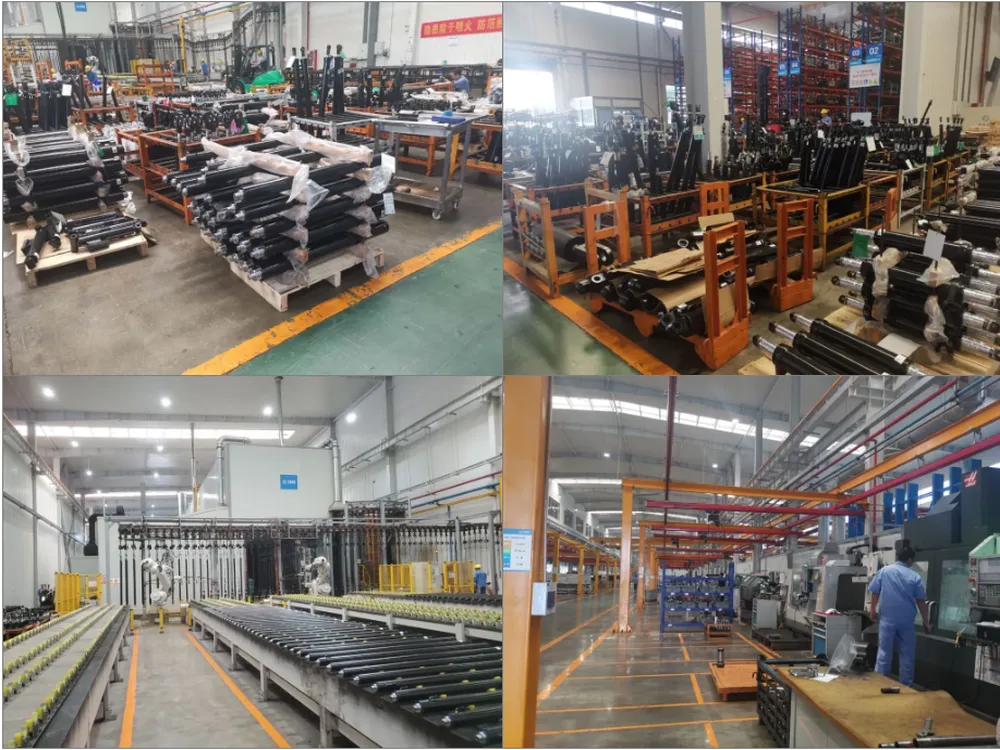
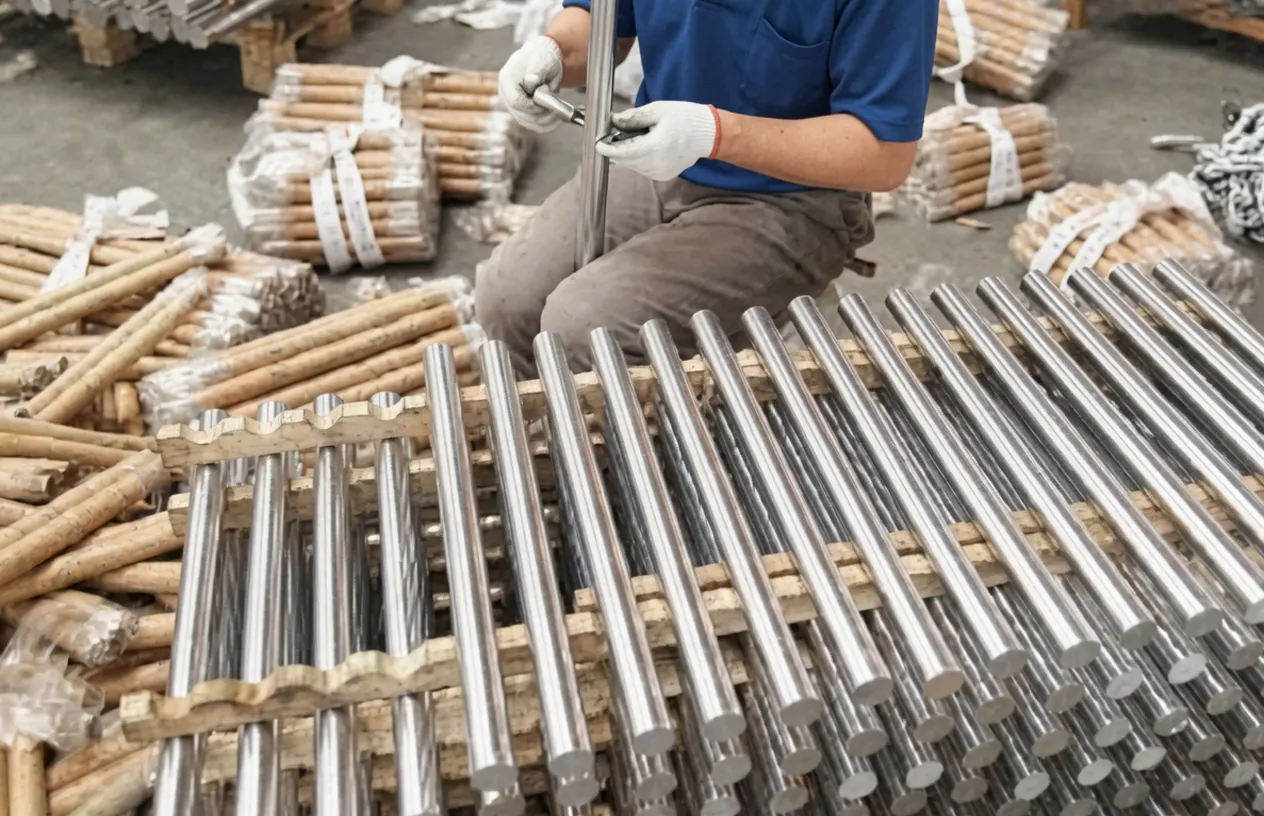
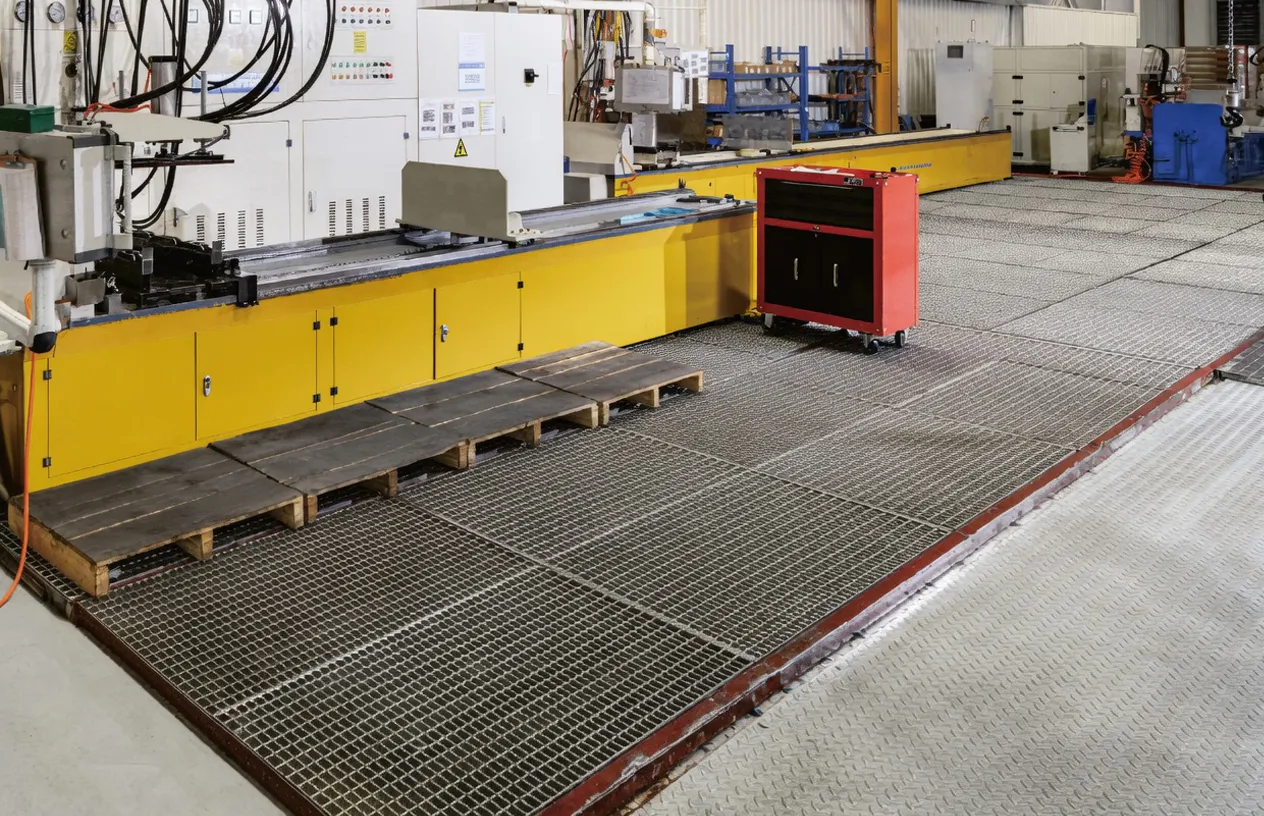
We are a professional manufacturer of hydraulic lifting cylinders for aerial work vehicles, industrial lifting equipment, and mobile material handling machinery. Our product range covers single-acting and double-acting hydraulic lift cylinders, forklift lifting cylinders, forklift tilt cylinders, and telescopic hydraulic cylinders for dump trucks and agricultural equipment. Our manufacturing facility operates precision CNC turning, hard chrome rod plating, barrel honing, and automated seal assembly lines to produce consistent quality lifting cylinders across production volumes from prototype to series supply.
We supply aerial work vehicle manufacturers, construction equipment maintenance organizations, and access equipment rental fleet operators across France, Germany, Belgium, the Netherlands, Italy, and Spain with both new OEM lifting cylinder supply programs and aftermarket replacement cylinder supply. Technical documentation for French and EU regulatory compliance — including EN 280 hydraulic cylinder test reports, material certificates, and dimensional drawings with French annotation — is available on request for all supplied lifting cylinder models.
WorkShop
9. Compatible Products — Complete Aerial Work Vehicle Hydraulic System
The lifting cylinder is the primary elevation actuator in the aerial work vehicle hydraulic circuit, but the complete system requires compatible hydraulic components for reliable platform operation.
Tilt Cylinder Series
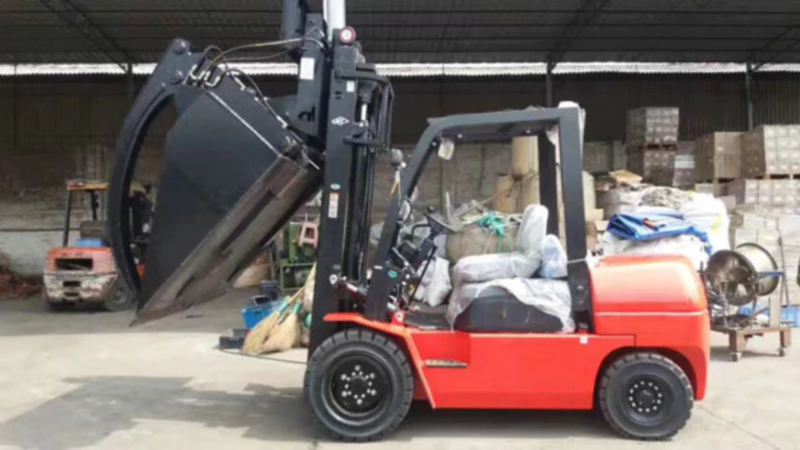
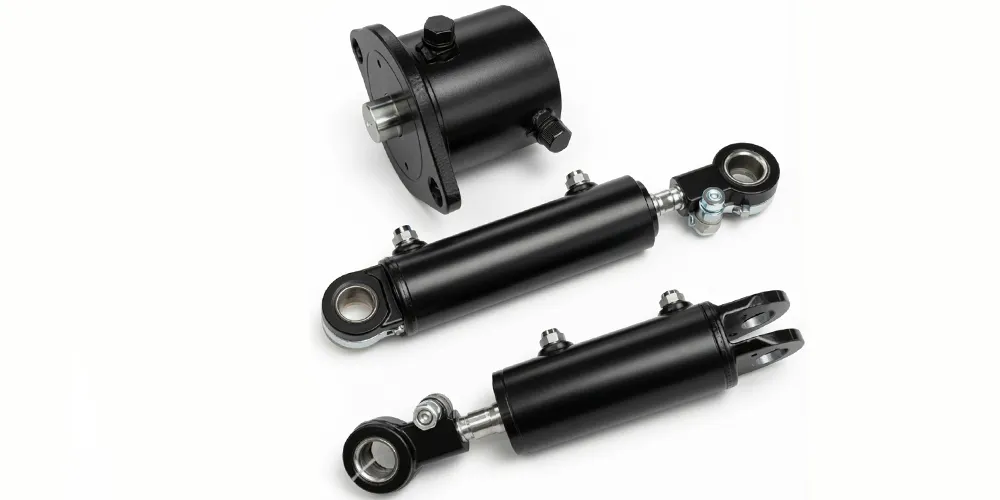
Many aerial work vehicles incorporate a Cilindro di inclinazione in addition to the main lifting cylinder to provide mast leveling, platform angle adjustment, or outrigger stabilization functions. Our complete tilt cylinder range covers multiple bore and stroke combinations for aerial work vehicle and construction equipment applications across the French and European market, with double-acting designs rated to the same European standards as this lifting cylinder for design file compatibility when both cylinders are specified together for a new platform development or fleet refresh program.
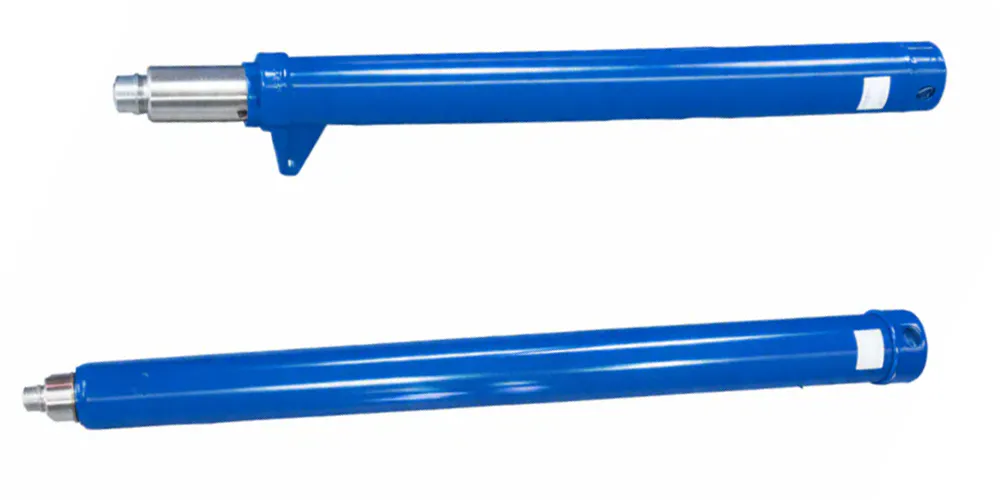
Cilindro di sollevamento per carrello elevatore
Our Cilindro di sollevamento per carrello elevatore range extends the lifting cylinder product family into forklift mast applications, where the vertical lift actuator operates in a guided channel rather than as a pin-mounted arm actuator. French logistics, warehouse, and manufacturing B2B buyers maintaining mixed fleets of forklifts and aerial platforms can source both lifting cylinder types from our product range with consistent quality standards and documentation.
Hydraulic Pump Station
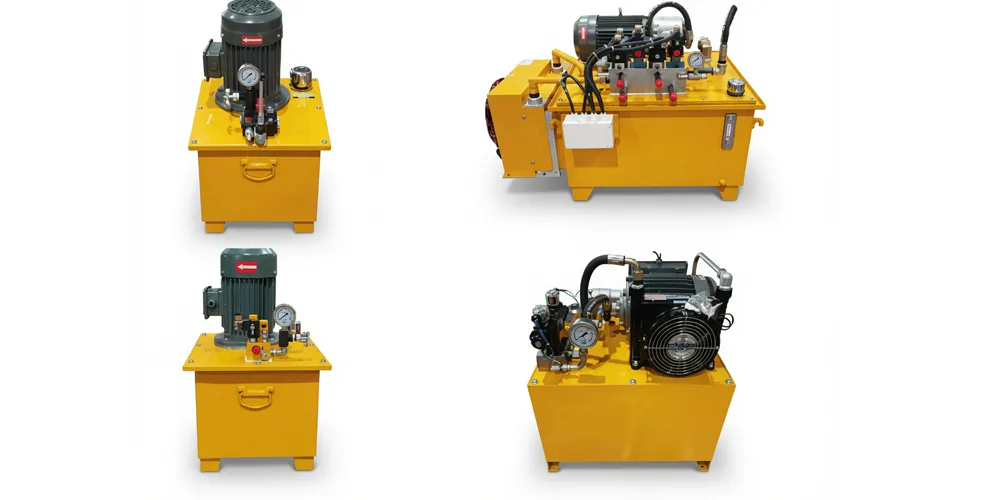
The hydraulic pump station generates the 18 MPa working pressure that actuates the lifting cylinder. Our pump station units configured for aerial work vehicle hydraulic systems cover both AC-powered electric versions for indoor use and battery-powered DC motor versions for outdoor self-propelled platforms. Specifying the pump station and lifting cylinder from the same supplier ensures that the pump flow rate, system relief valve setting, and hydraulic oil viscosity are matched to the cylinder bore area and stroke for consistent platform lift speed, eliminating the trial-and-error hydraulic circuit adjustment that occurs when incompatible components from different suppliers are combined during aerial work vehicle assembly or major maintenance.
Frequently Asked Questions
Q1. What is an aerial work vehicle lifting cylinder and how does it differ from a standard industrial hydraulic lift cylinder?
An aerial work vehicle lifting cylinder is a long-stroke single-acting hydraulic lift cylinder specifically engineered for the elevation circuit of scissor lifts, boom lift platforms, and trailer-mounted elevated work platforms. It differs from standard industrial hydraulic lift cylinders in three main ways: the stroke length of a lifting cylinder is significantly longer (often 1000 to 1500 mm versus 200-600 mm for typical industrial cylinders) to contribute to the large platform elevation height required; the mounting flange is typically wider to distribute the structural bending moment across the aerial platform frame; and the safety system integration — lock valves, velocity fuses, and emergency descent controls — must comply with EN 280 mobile elevating work platform standards applicable in France and the EU, not just the general EN ISO 10100 hydraulic cylinder standard.
Q2. Where can I find a reliable aerial work vehicle lifting cylinder supplier in France or Europe with fast delivery and EN 280 compliance documentation?
We supply lifting cylinders to French aerial platform manufacturers, service centers, and rental fleet operators with European port CIF supply terms and EN 280 compliance documentation including dimensional drawings, pressure test certificates, and material certificates. Standard catalogue lifting cylinders typically ship within 15-25 days to French delivery addresses. Contact our export engineering team with the lifting cylinder specification (bore, rod, stroke, working pressure) and installation distance for a technical confirmation and quotation within 24 business hours.
Q3. What is the maximum platform height that the EP-Φ65×Φ45×1260 lifting cylinder can contribute to in a scissor lift platform design in France?
The 1260 mm stroke of this lifting cylinder translates to a platform height contribution that depends on the scissor geometry of the specific platform design. In a typical double-scissors configuration with a mechanical advantage ratio of approximately 3.5 to 4, the 1260 mm lifting cylinder stroke contributes 4.4 to 5.0 metres of vertical platform height. For a single-scissors configuration with a mechanical advantage of approximately 2.5, the contribution is 3.1 to 3.2 metres. The total working height of the aerial work vehicle adds the collapsed platform height to this lifting cylinder contribution. French scissor lift platforms in the 8 to 12 metre working height class most commonly specify this cylinder stroke range for their elevation circuit.
Q4. What working pressure does the EP-Φ65×Φ45×1260 lifting cylinder operate at, and is it compatible with standard European aerial work vehicle hydraulic systems?
The EP-Φ65×Φ45×1260 lifting cylinder is rated at 18 MPa (180 bar) working pressure — the standard operating pressure range for scissor lift and boom lift hydraulic elevation circuits in the European market. The 27 MPa maximum withstand pressure satisfies the EN 280 requirement that aerial work vehicle hydraulic lifting cylinders sustain 1.5 times the maximum system pressure without permanent deformation. The G25 BSP port threads at the mounting flange are the standard European connection for this lifting cylinder class and accept standard European hydraulic hose fittings and counterbalance valve adapters used in French aerial work platform hydraulic circuit designs.
Q5. Which hydraulic oil is recommended for the lifting cylinder circuit on an outdoor scissor lift operating at construction sites in northern France during winter?
For outdoor scissor lift platforms operating on construction sites in northern France during winter months (October to March), where ambient temperatures regularly fall below 0°C in Hauts-de-France, Grand Est, and Normandy regions, we recommend ISO VG 32 or ISO VG 46 low-temperature hydraulic oil with a pour point below -30°C and a viscosity index above 130. This grade maintains adequate fluidity at cold start conditions and prevents sluggish lifting cylinder response during morning startup before the oil reaches normal operating temperature. The seal materials in the EP-Φ65×Φ45×1260 lifting cylinder are compatible with standard mineral-base VG 32-46 hydraulic oils at temperatures from -20°C to +80°C, covering the French winter outdoor operating temperature range.
Q6. What are the signs that an aerial work vehicle hydraulic lift cylinder needs replacement rather than seal kit renewal in a French rental fleet?
Complete lifting cylinder replacement is necessary rather than seal kit renewal when any of the following conditions are identified during inspection: the hard chrome rod surface shows scratches deeper than approximately 0.1 mm that would cut new seals; corrosion pitting penetrates through the chrome layer into the base rod steel; the barrel bore ovality exceeds 0.05 mm from wear or contamination damage; the mounting flange plate shows cracks or deformation from impact or overload; or the lifting cylinder has been involved in a structural impact event that may have caused rod bending beyond the straightness tolerance required for smooth seal operation. French aerial work vehicle rental fleet operators conducting CACES R486 maintenance inspections identify these conditions during the scheduled quarterly hydraulic system check required under French rental equipment maintenance regulations.
Q7. How does the wide flange mounting plate of the EP-Φ65×Φ45×1260 cylinder contribute to aerial work platform structural safety in France?
The 344 mm square flange plate distributes the lifting cylinder reaction force — compressive under elevation, tensile under retraction for double-acting circuits — across a large contact area on the scissor frame lower beam. This distribution prevents localized stress concentration that would cause fatigue cracking at the cylinder attachment point over the many thousands of elevation cycles accumulated during a 5 to 10 year rental fleet service life. For French aerial work platforms certified under EN 280 for category I or II use (ground conditions), the lifting cylinder mounting interface is a structural calculation point that must satisfy fatigue life requirements under the platform design documentation submitted to the notified body for CE marking — which the wide flange design supports by reducing peak stress at the attachment point to well below the material fatigue limit.
Q8. What aftermarket hydraulic cylinders are available for aerial work platforms operating in France and how do I verify dimensional compatibility before ordering?
We supply aftermarket lifting cylinders for aerial work platforms with the following verification process to ensure dimensional compatibility before order confirmation: provide us with the existing lifting cylinder model number (if legible), measured bore diameter, rod diameter, stroke, closed length, flange plate dimensions, and port specification; we cross-reference against our catalogue to identify a direct replacement or advise on the closest available specification. For French aerial work platform fleet maintainers with mixed-brand equipment, we can develop a lifting cylinder cross-reference list mapping their existing OEM cylinder numbers to our aftermarket replacement specifications to simplify future re-order processes without repeat measurement cycles.
Q9. When should the hydraulic cylinder seal replacement be scheduled for aerial work vehicle lifting cylinders in a high-cycle French industrial maintenance fleet?
For aerial work vehicles in high-cycle French industrial maintenance applications — such as automotive plant overhead equipment servicing with 8 to 12 elevation cycles per working day, 240 days per year — the lifting cylinder seal replacement interval should be based on the cumulative operating cycles rather than a fixed time interval. A preventive seal kit replacement at 15,000 to 20,000 elevation cycles is a reasonable starting point for standard polyurethane seal grades in clean indoor environments with good hydraulic oil filtration. In higher-contamination environments such as outdoor construction sites in dusty conditions, or in cold storage plants where the wiper seal faces condensation and freeze-thaw cycling, the lifting cylinder inspection interval should be shortened to every 8,000 to 10,000 cycles to detect seal degradation before external hydraulic oil leakage triggers a French workplace safety removal from service under INRS aerial work platform operation recommendations.
Source the EP-Φ65×Φ45×1260 Aerial Work Vehicle Lifting Cylinder
Contact our export engineering team for technical specifications, OEM or aftermarket supply quotations, and CIF European port delivery documentation for lifting cylinder supply to aerial work platform manufacturers and fleet operators across France and Europe.
Editor: PXY